
If you’re specifying or troubleshooting a hydraulic system, the vane pump is one of the three pump types you’ll run into most often — alongside gear pumps and piston pumps. It sits in a useful middle ground: quieter and more efficient than a gear pump, simpler and less expensive than a piston pump. Here’s a practical look at how it works, where it fits, and what to watch for.
How a Hydraulic Vane Pump Works
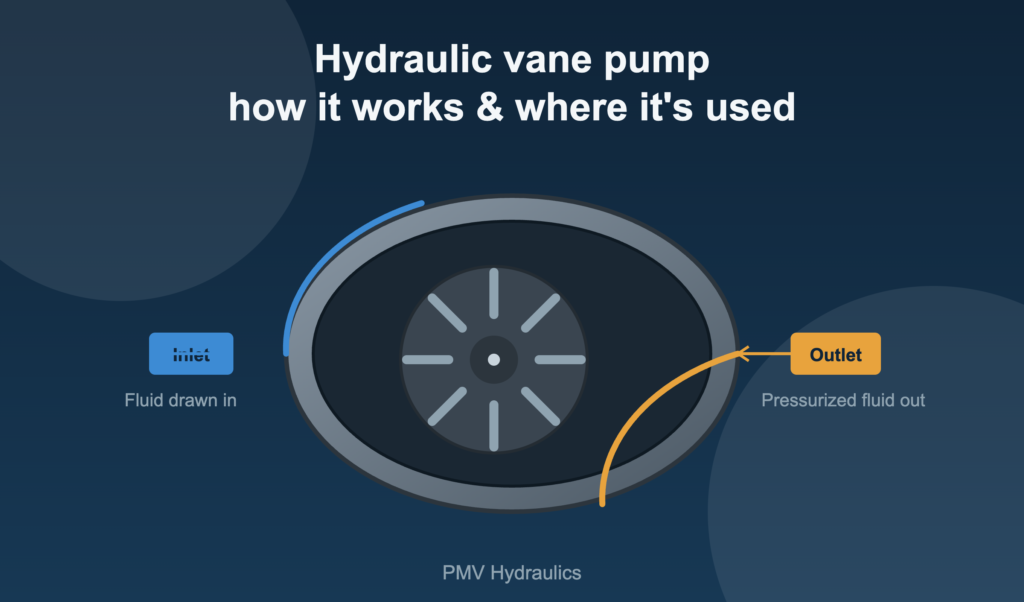
A vane pump is a positive displacement pump, meaning it moves a fixed amount of fluid with every rotation regardless of pressure. Inside the pump, a slotted rotor sits off-center within a circular (or elliptical) cam ring. Flat vanes fit into the slots of the rotor and slide in and out as it spins, pushed outward by centrifugal force, hydraulic pressure, or small springs so they stay in constant contact with the cam ring wall.
Because the rotor is mounted eccentrically, the space between the rotor and the ring wall changes as it rotates — expanding on one side and contracting on the other. As the vanes sweep through the expanding zone, they draw fluid in through the inlet. As they move into the contracting zone, that fluid gets pushed out through the outlet under pressure. This continuous expansion-and-contraction cycle is what gives vane pumps their smooth, consistent flow.
Most industrial vane pumps also use a balanced design — two inlet and two outlet zones per rotation instead of one. This cancels out the side-loading forces on the shaft, which is a big part of why balanced vane pumps tend to have a long service life with relatively low bearing wear.
Advantages of Hydraulic Vane Pumps
- Quiet operation — noticeably lower noise levels than gear pumps, which matters in enclosed machinery or indoor plant environments.
- Consistent, stable flow — the pumping action is smooth, with less pressure ripple than a gear pump.
- Good efficiency at moderate pressure — vane pumps run efficiently without excessive power loss, as long as they’re kept within their rated pressure range.
- Self-compensating for wear — because the vanes can extend slightly, the pump partially compensates for minor internal wear over time, which helps maintain performance between services.
- Compact footprint — easy to integrate into space-constrained machine designs.
Limitations to Be Aware Of
- Sensitive to oil cleanliness — vane pumps are less tolerant of contaminated fluid than gear pumps. Dirty oil accelerates wear on the vanes and cam ring, so filtration matters more here than with some other pump types.
- Moderate pressure ceiling — vane pumps are generally suited to low-to-moderate pressure applications. For very high-pressure demands, an axial or radial piston pump is usually the better choice.
- More moving parts than a gear pump — which means marginally higher maintenance requirements and cost over the pump’s life.
- Not ideal for high-viscosity or abrasive fluids — thin, clean hydraulic oil is where vane pumps perform best.
Common Applications
Hydraulic vane pumps show up across a wide range of equipment where quiet, consistent flow at moderate pressure is the priority:
- Power steering systems in automotive and off-highway vehicles
- Industrial presses and hydraulic lifts
- Machine tools
- Material handling equipment
- Injection molding machinery
- Mobile hydraulics on construction and agricultural equipment
Vane Pump vs. Gear Pump vs. Piston Pump — Quick Guide
| Vane Pump | Gear Pump | Piston Pump | |
|---|---|---|---|
| Noise level | Low | Higher | Low–moderate |
| Pressure range | Low–moderate | Low–moderate | Moderate–high |
| Cost | Moderate | Lowest | Highest |
| Sensitivity to contamination | Higher | Lower | Higher |
| Best for | Quiet, stable-flow applications | Simple, budget-sensitive systems | High-pressure, heavy-duty applications |
If your application needs high pressure above what a vane pump is rated for, a piston pump is worth considering instead — we cover that comparison in more depth in our [piston pump vs. vane pump breakdown]. For a deeper technical walkthrough of vane pump internals and the different sub-types (unbalanced, balanced, and variable-displacement designs), Learn Mechanical Engineering has a detailed technical guide on vane pump types and working principles worth a look.
Keeping a Vane Pump Running Longer
Since oil cleanliness is the main variable that determines vane pump lifespan, the highest-value maintenance step is filtration — keeping particulate contamination out of the system and changing the hydraulic oil on schedule rather than by the calendar alone. Beyond that, watching for the early warning signs we covered in our [earlier post on hydraulic pump failure] — unusual noise, weaker performance, overheating, leaks, and discolored oil — will catch most vane pump problems before they turn into a full rebuild.
Need Help Choosing or Repairing a Vane Pump?
Whether you’re specifying a vane pump for a new build or trying to diagnose one that’s underperforming, we can help. PMV Hydraulics supplies and repairs vane pumps and other hydraulic components across major brands, with diagnosis, rebuilds, and testing done in-house.
📞 Talk to us: WhatsApp +91-9911797178 or call for a consult.
FAQs
1. What’s the difference between a vane pump and a gear pump?
A vane pump uses sliding vanes in a rotor to move fluid, giving smoother, quieter operation and better efficiency at moderate pressure. A gear pump uses meshing gear teeth, which is simpler and cheaper to manufacture but noisier and slightly less efficient. Vane pumps are generally the better choice where noise and flow consistency matter; gear pumps are often chosen for simpler, lower-cost applications.
2. What causes a hydraulic vane pump to fail?
The most common cause is contaminated hydraulic oil — dirt or metal particles accelerate wear on the vanes and cam ring. Other common causes include running the pump beyond its rated pressure, using the wrong oil viscosity, and cavitation from a restricted inlet or low fluid level.
3. Can a hydraulic vane pump be repaired, or does it need to be replaced?
In most cases, a vane pump can be rebuilt rather than replaced — worn vanes, cam rings, and seals can typically be serviced or replaced at a fraction of the cost of a new unit, provided the housing and shaft haven’t sustained major damage.
4. How long does a hydraulic vane pump typically last?
Service life varies significantly with operating conditions, but a well-maintained balanced vane pump running on clean, filtered oil within its rated pressure range can run for several thousand hours before needing a rebuild. Poor filtration and pressure overload are the two factors most likely to shorten that lifespan.